Do you write code?

Stackoverflow is the most addictive developer's resource. Go check it out now! I use it myself, and I got to tell ya, they don't call it "crack overflow" for nothing.

Joel helped me find my current job. Check out the Joel on Software job board if you are not happy with yours.

Evernote is the best code, memo, photo, todo, wishlist application I've ever used. Mad props for making Memex real.

What's All this Then?

My name is Michael Krakovskiy, and this is my blog.

Here's what you might find interesting:
100 Views of the Empire State Building project: I try to take 100 interesting photos of Manhattan's (sadly) tallest building.

My Gastronomic Adventures: I eat weird food - from 13 year old New Coke to Durian and parasitic fungi.

My attempts to grow exotic plants: pineapples, coconuts, etc.

My photos, mostly of New York City.

My musings about architecture mostly illustrated with my own photos. Would you like to learn about a mental patient who died at 103 who served as a model for some very famous sculptures? How about Brooklyn's ugliest building? How about a wooden skyscraper?

I find myself frequently writing about logos. The most popular article I ever wrote is about the redesigns of the Starbucks logo.

I wrote a series of "Best Sci-Fi You Haven't Read" posts:

Psywarrior
Yes, Virginia There Is Synergy
Call Time Police - We've Got a Time Traveler

Other topics that interest me include NYPD, New York City subway system, Japan, and things made out of titanium. On top of all of that, I seem to be interested in pigeions and Rupert Murdoch.

Dear reader, please browse around. You are sure to find something interesting. I could really use some help in bringing in readership: subscribe to the rss feed, digg the stories (there's a convenient button at the bottom of every article), link to my blog from yours, write some comments. I put in a lot of effort into writing, and I really appreciate your attention.

If you don't want all this pseudo-intellectual and want some lolcats? Please don't go away. Here, I have that stuff too. Here, here's another. And another. And another. I lied about not posting cat pictures.


Deadprogrammer Visits The Radiator Planet

If you live in New York, chances are pretty high that you live in an apartment building. We, young generation X-ers, face a tough choice. To be able to afford a house without Google stock options, you need to move either to New Jersey (technically ceasing to be a New Yorker) or to Staten Island. Which is a fate worse than death. The rest, find refuge in the bajillion of apartment buildings on the Isle of Long or in Manhattan itself. There are also some in Jersey City, Queens and the Bronx. Apartment living is a reality for most Manhattanites and card-carrying members of the Bridge and Tunnel society, such as myself.

I don't think I've ever seen central air heating in a New York apartment. Apartments here are heated with radiators. Radiators are noisy, prone to overheating and generally troublesome. As the heating season is about to start, let me share with you my wealth of radiator knowledge.

There are three major heating system types common to the New York area: water, one pipe steam and two pipe steam. Only the oldest buildings have water heating, if you have one of those, you are on your own. I've never seen a two pipe steam system either, so the only one I can tell you about is the almost century-old technology - the one pipe steam radiator with a Hoffman valve. It's very, very likely you have one of these.
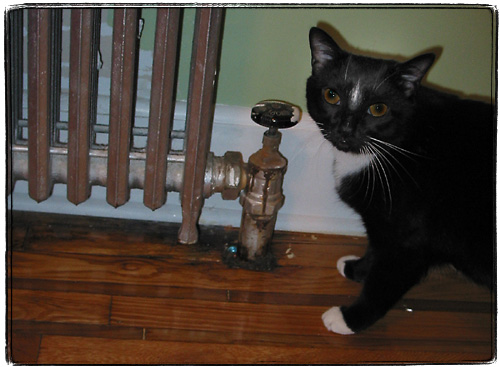
In this picture Gary the cat shows you what a typical single pipe system looks like. It's basically a steam-carrying pipe sticking out of the floor, connecting with your radiator via a valve. A mistake that most people are making, is thinking that by twiddling with this valve it's possible to control the temperature. This is absolutely wrong. In theory, you should be able to open and close this valve to start or stop the flow of steam. In practice, as most of these are very old, the gaskets don't hold steam at all even in the closed position. Closed and half-open position usually does not result in much other than noise from the condensed water that can't get back down and leaks.

This heating system is very simple. Steam enters the radiator through the pipe, condenses as water and leaves down the pipe. It has numerous advantages: steam is more efficient than heated water, there's next to no chance of the system freezing (when that happens to a water-heated radiator on the coldest day of the winter, it's not a lot of fun - just ask Joel). Steam radiators like this existed in Victorian times as well, with one exception. They tended to explode if too much pressure was applied, maiming and killing hapless apartment dwellers. That's why so many brownstones have water-heated systems.

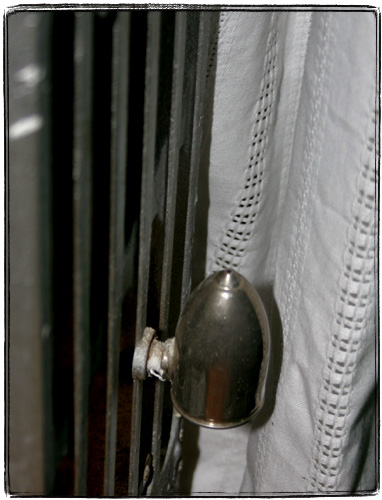
In 1913 George D. Hoffman started a company that produced an ingenious little device that made steam radiators safe. If you look at your radiator, you'll find a little vent that usually looks like a miniature rocket ship (as you can see both my radiator and the valve have Streamline / Art Deco styling very popular in the period when my building was built). Chances are, it will be a Hoffman Specialty Model 40. This device works like a not very bright Maxwell's demon: it lets air enter the radiator or escape, but stops steam from escaping.

The whistling noise that you hear at night is air escaping the radiator when it fills up with steam. If the vent is not correctly sized or, which is more frequent, got clogged up with mineral deposits, you will hear water and steam spurting out of it and destroying your neighbor's ceiling. Worst case scenario - the valve gets stuck on open and fills your entire room with steam, ruining the walls and possibly burning you. When changing a clogged valve, make sure that the steam is off and is going to stay off while you change it, and be around when the steam is going back on to make sure that there are no leaks.

Even if you have a properly sized and regulated valve and you pitch the radiator towards the pipe to let the water drain without making much "water hammer" noise, it's likely that your apartment will be overheated. Most are. As the intake valve is usually out of commission, the best way to turn off the radiator is to close the steam valve by turning it upside down (I've heard about this trick on This Old House. This is rather inconvenient and a bit dangerous - you might strip the threads and end up with a whole room full of steam. My guess is that there would not be an explosion as the valve is engineered to open if the pressure is excessive. Maybe not, I don't know.

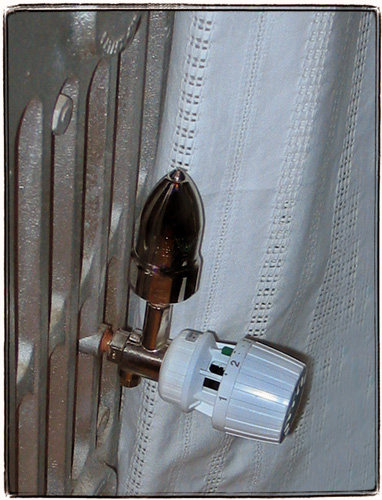
The best thing to do is to purchase a regulated thermostatic valve. These are improved valves with a sensor that closes the valve when the temperature reaches a certain level. While not perfect, these really let you exert a tiny bit of control over your apartment's temperature. It also lets you easily shut down the radiator, as sometimes the buildings overheat so much, that you don't need heat at all.

The kit usually consists of three parts: a temperature control device, an adaptor and a Hoffman-type valve. This will run you about $100 altogether. I have one on two radiators, and let me tell you, these are worth every penny.
P.S. I am rather curious as to what George D. Hoffman looked like and what his life story was. Somehow I imagine him as a fat dude in a three piece suit with some ridiculous Victorian hair and beard-style. If you ever find a picture of him, please let me know. All I could dig up was an old brochure (PDF) that featured the Hoffman company logo: "The Use of Hoffman Valves Make a Poor Job Better A Good Job Perfect."


Ad:

Don't you wish you could peer inside the walls to see if there are electric wires there, or leaking pipes? Well, now you can with a Fiberoptic Borescope for way under 200 bucks!

Milwaukee drills are some of the finest drills ever.
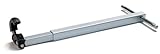
Basin wrenches are some of the most useful tools missing from most toolboxes.
No votes yet

Comments

Tue, 11/22/2005 - 08:47 — pUnk (not verified)

The purpose of the vent isn't to release pressure so things don't explode, it's there to allow air to escape so steam can enter the radiator. True, there was a period of high-pressure steam boilers in use, but most (all?) residential heating systems in service today use low pressure steam at around 2 or 3 psi.

Tue, 11/22/2005 - 08:53 — deadprogrammer

Well, the way I understand it, the old systems used high pressure to overcome the formation of air pockets. Also, I was talking about pre and post Hoffman valve systems at the turn of the century.

Thu, 11/17/2005 - 21:14 — Kurtis McCathern (not verified)

Hey, this is great! I am trying to do THIS EXACT THING and I can't find anybody in Chicago who can give me any help or information.

What kind of operator did you use? Where did you get it? Did you DIY this or did you have a plumber come do it?

Any kind of additional detail would really help me out.

Thu, 11/17/2005 - 21:23 — deadprogrammer

I went to my local plumbing supply, Island Plumbing, showed them a picture of my old regulator, and they helped me pick the T-connection, the new valve (same as the old, but with the connection on the bottom) and the thermostatic control unit(the white handle thingy). I installed it myself - it's just making threaded connections with teflon tape.
I could not find a place that sold these online, but there must be dozens of plumbing supply houses in your area. Just look for one that caters to both professionals and homeowners. Also, if you are not mechanically inclined, ask a plumber to do this for you - it's a simple job, about 15 minutes per radiator.

Sat, 10/22/2005 - 00:55 — bullet (not verified)

I could have used this a few years ago when I was in NYC and awakened every night by the deafening rattling and hammering of the radiator. How come my super(s) never knew how to fix this stuff? It's funny how much New Yorkers will subject themselves to because they think it's just the way it's going to be. :) Thant being said... what do you use a basin wrench for?

Sat, 10/22/2005 - 01:07 — deadprogrammer

New York city supers range from ones who are completely mechanically inept to those that can take apart a boiler system, fix it and put it back together. Water hammer problems are very fixable. They are usually paid in accordance with their skillset.

Basin wrench is good for unscrewing pipe fittings in very tight quarters, like under the sink.

Sun, 10/23/2005 - 18:05 — abu vee (not verified)

Hey great website. I enjoy reading it here in the sandbox (Iraq). Anyways, I'm quite interested in this borescope tool. Do you have one? If so, please post some pictures/results from it. looks fascinating.

-abu vee

Mon, 10/24/2005 - 02:53 — deadprogrammer

Thank you for the compliment. I guess there aren't many problems with radiators in Iraq. I see a bit of hits from .mil domains from time to time in my blogs, but you are probably the first person form Iraq to actually comment.

As to the borescope, I don't have it yet. It's mighty tempting, seeing how cheap it is, but I haven't actually purchase one for myself. I'll probably get one soon, and I'll post a review with pictures and everything.

Mon, 10/24/2005 - 23:51 — Developer Unruh (not verified)

In my quest to learn about steam heat, this book seems to be higly recommended :
http://www.amazon.com/exec/obidos/tg/detail/-/9993251747/102-8055359-2028149?v=glance.

Wed, 11/02/2005 - 01:59 — Monday Monkey (not verified)

The slogan reminds me of PERL: "Makes easy things easy and hard things possible."

Mon, 11/28/2005 - 22:28 — Anonymous

can you post the book name, please? i tried following this link and amazon's saying that it's out of date?

Mon, 11/28/2005 - 22:33 — Anonymous

actually, i think i found it by searching for pieces of that URL you provided ... i'm thinking it's called "The Lost Art of Steam Heating" by Dan Holohan ... although i can't actually find a copy on the internet to purchase!

Mon, 11/28/2005 - 22:37 — Anonymous

ha ... i should have been more patient:

http://www.heatinghelp.com/shopcart/product.cfm?category=2-3

this site also appears to have a personal message from dan (the author)

Sat, 12/10/2005 - 00:53 — Anonymous

So I found your blog while trying to figure out why water is pouring out of my my valve and how I might fix it myself (my super is so incompetent (who really shouldn't be called super) has replaced it already yet nasty water still continues to pour out) any ideas how we can fix it our selves? The open/close valve works so we can completely shut it down but doesn't fix it.

Do you recommend Island Plumbers? They are in Brooklyn and so are we...

Fri, 12/23/2005 - 20:09 — Sarah (not verified)

Hi,

I live in an old, vintage (1920s) building that uses radiator heating. My heat has not come on in a few days, and when I called the on-site manager, she said it had to do with the temperature and that she would "turn the thermostat up". The radiator came on for about 10 minutes and then hasn't been on since--AT ALL.

My question (maybe you didn't need the background info) is--are these hooked up per apartment? Each apartment has control over it's heat or is it truly that it comes on when it wants to? Because it's COLD in here, and I can't figure out why this wouldn't be fixed if all the radiators were controlled by the same valves.

Thanks. I hope that made sense.

Sarah

Tue, 01/17/2006 - 03:23 — Roy (not verified)

Hi,

I am writing with regards to your "Deadprogrammer Visits The Radiator Planet" posting and was just wondering where I might purchase the regulated thermostatic valve you show. I've looked all over for it.

If you don't have a link to the unit do you by chance know the make and part/model #?

Thanks in advance for your help.

Tue, 01/17/2006 - 04:44 — deadprogrammer

The parts that you need highly depend on the make of your radiator. I took a picture of mine and measured the thread size, then went to Island Plumbing & Heating, where they helped me pick the parts.

Thu, 06/08/2006 - 19:14 — afterburner (not verified)

oh yeah, steam radiator knowledge is at a premium these days. Nobody knows anything about it. I think most of us are on our own. I'm trying to replace the shut off valve on mine... BEWARE all steam valves are not created equal. Seems each manufacturer uses a different spud/nipple size. Anyone know where I can find a 1-1/4" Chicago Specialty Mfg. Co. shut off valve?

Thu, 06/08/2006 - 19:29 — afterburner (not verified)

if water is pouring out of the relief valve (the one opposite the shut off vavle) it should be replaced. Theses are pretty cheap. They work with a float inside that shuts off the relief when water gets up to it.

Mon, 12/04/2006 - 22:17 — Anonymous

afterburner......Problem here in Montana looking for Shut off Valve...Any luck???

Mon, 12/04/2006 - 22:18 — Anonymous

any luck finding shut offs?

Mon, 05/19/2008 - 20:31 — Ben Murphy (not verified)

Hey, great post! We just purchased a historic 1861 house and I'm quickly getting to know radiator heat (in a good way so far)... I found your post to be most helpful! -BM

Fri, 07/18/2008 - 17:09 — Anonymous (not verified)

Looking at this same idea for my 1917 place.

The company that I've found that makes the valve setup is Danfoss.
For a single pipe steam system, you'd need the following:
RA-2000 013G0140 (Valve for 1 pipe steam)
013L8011 (Air vent for 1 pipe steam)
RA-2000 013G8250 (Valve mounted dial and sensor)

I haven't tried any of these yet.

Post new comment

The content of this field is kept private and will not be shown publicly.
  • Allowed HTML tags: <a><b><i><img>
  • Lines and paragraphs break automatically.

More information about formatting options


 Subscribe in a reader

Hey!

Jesse Reklaw's Slow Wave comics absolutely rock!. Jesse designed Deadprogrammer.com corner graphic, the one with the programmer and the cat. And now you can buy his new book - The Night of Your life: